The History of Chocolate: A Complete Timeline from Ancient Mesoamerica to Today
By Gideon Rubin in History Posted October 3, 2023 Tags Infographic
Chocolate is one of the most traded commodities on earth, with a global market valued at over $130 billion and a story stretching back more than 4,000 years. But to understand where chocolate is going – its craft renaissance, its sustainability crisis, its return to single-origin terroir – you first need to understand where it came from.
This timeline traces the key milestones in chocolate’s history, from the first cacao farmers in ancient Mesoamerica to the award-winning bean-to-bar makers redefining what chocolate can be today.
Ancient Mesoamerica: Where Chocolate Began
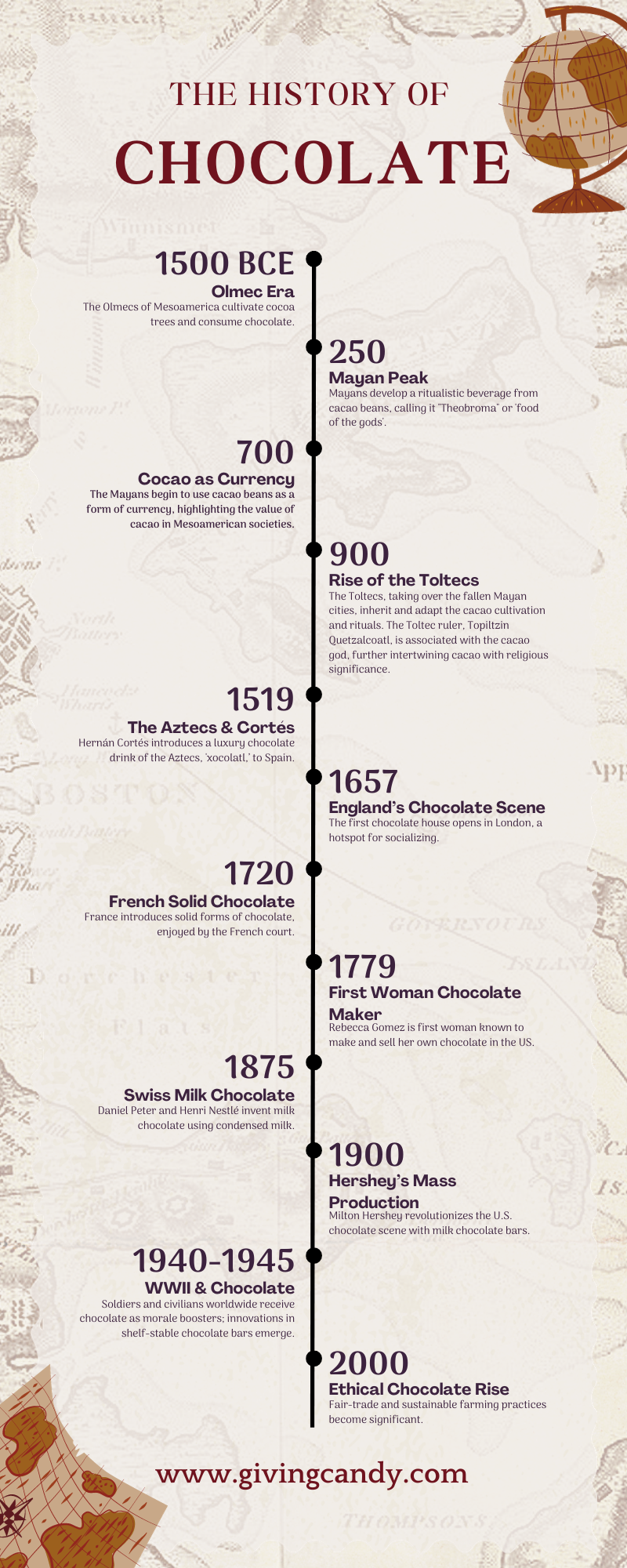
~2500 BCE – The Olmec Domesticate Cacao
Archaeological evidence places cacao use in Central America at least 4,500 years ago. The Olmec people of what is now southern Mexico were among the first to domesticate wild Criollo cacao trees, a process confirmed by vessel residue analysis at sites like San Lorenzo, Mexico (dated 3,800-3,000 BP) and El Manati (3,650 BP). The Olmecs called the tree kakawa – the root of the word “cacao” we use today.
Early cacao beverages were likely fermented pulp drinks rather than what we would recognize as chocolate. The shift toward seed-based drinks – closer to true chocolate – appears to have occurred around 3,000 years ago, evidenced by changes in vessel shapes at archaeological sites.
~1500 BCE – Systematic Cultivation
By roughly 1500 BCE, organized cacao cultivation was established across Mesoamerica. The Olmecs, and later the Maya and Aztec civilizations, engaged in centuries of active hybridization and selective breeding – not just growing cacao, but deliberately improving it for flavor. This represents one of the earliest known programs of agricultural refinement for taste.
~250 CE – The Maya and “chikolatl”
At the height of Classic Maya civilization, cacao held deep ceremonial, economic, and nutritional significance. The Maya crafted a frothy drink from cacao beans that scholars now believe they called chikolatl (not “xocolatl” as is often repeated – that is an Aztec-era term). The scientific genus name Theobroma – meaning “food of the gods” in Greek – was assigned much later by Swedish botanist Carl Linnaeus in 1753, not by the Maya themselves.
Cacao was consumed at births, marriages, and funerals. Vessels depicting cacao rituals appear throughout Maya ceramics and codices.
~700 CE – Cacao as Currency
The Maya formalized cacao’s economic role by using dried beans as currency – a practice that reflected how deeply embedded the crop was in their society. Transactions, taxes, and tribute were all settled in cacao.
~900 CE – The Toltecs Inherit the Tradition
As Classic Maya cities declined, the Toltecs rose in central Mexico, absorbing and perpetuating cacao cultivation and its associated spiritual framework. The ruler and deity Topiltzin Quetzalcoatl became closely identified with cacao in Toltec mythology. According to Aztec legend, it was Quetzalcoatl – the feathered-serpent god – who brought cacao from the divine realm to humanity.
1519-1528 – Cortés, the Aztecs, and Europe’s First Taste
When Hernan Cortes arrived in the Aztec empire in 1519, he encountered a cacao drink the Aztecs called xocolatl. Spanish colonizers initially found it bitter, but Dominican monks later combined it with cinnamon and cane sugar, creating a sweetened version that spread rapidly through the Spanish aristocracy. By 1528, cacao beans and the recipe had arrived in Spain, where the sweetened drink became fashionable among the elite and was kept secret from the rest of Europe for nearly a century.
Chocolate Travels the World: 1600s-1800s
1657 – England’s First Chocolate House
London’s first chocolate house opened in 1657, rapidly becoming a social institution. These establishments were forerunners of the modern coffee shop – places where merchants, politicians, and intellectuals gathered to drink chocolate and conduct business. Within decades, hundreds of chocolate houses operated across London.
1720 – The Move Toward Solid Chocolate
The concept of eating chocolate rather than drinking it emerged gradually in 18th-century France and Italy. Early solid chocolates were dense, grainy, and far removed from the smooth bars we know today – but the shift from beverage to confection had begun.
1779 – The First Known Woman Chocolate Maker in America
Rebecca Gomez became the first documented woman to manufacture and sell her own chocolate in the United States, an early signal that chocolate making was never exclusively a male trade.
1875 – The Invention of Milk Chocolate
Swiss chocolatier Daniel Peter, working with condensed milk developed by his neighbor Henri Nestlé, produced the first commercially successful milk chocolate bar. This discovery fundamentally changed the industry, making chocolate smoother, sweeter, and more accessible to mass audiences.
Industrialization and Its Shadow: 1900-1999
1900 – Hershey and Mass Production
Milton Hershey’s Pennsylvania factory brought milk chocolate to the American masses at scale. The efficiencies Hershey pioneered – standardized recipes, mechanized production, bulk commodity cacao sourcing – defined the dominant model of the 20th-century chocolate industry. The trade-off was terroir: mass-market chocolate blended beans from dozens of origins, erasing flavor distinctions in exchange for consistency and low cost.
1940-1945 – Chocolate in World War II
Chocolate’s caloric density, shelf stability, and morale value made it a military staple during World War II. The U.S. Army commissioned the Hershey Company to produce a field ration bar engineered to withstand tropical heat. These wartime demands accelerated research into heat-resistant formulations and extended shelf life – technical advances that shaped commercial chocolate for decades afterward.
The Late 20th Century – The Commodity Crisis Builds
The post-war decades saw chocolate consumption explode globally, fueled by industrial production and falling prices. Cacao farming became dominated by large monoculture plantations – primarily in West Africa, which today supplies roughly 70% of the world’s cacao. The consequences of this model: widespread deforestation, child labor controversies, farmer poverty, and the near-elimination of fine-flavor cacao varieties in favor of high-yield bulk hybrids.
The Craft Renaissance: 2000 to Present
2000 Onwards – The Rise of Ethical and Craft Chocolate
The turn of the millennium brought a reckoning. Investigative journalism and NGO reports exposed the human and environmental cost of cheap commodity chocolate. In response, the fair-trade movement grew, direct-trade chocolate emerged, and a new category – craft or “bean-to-bar” chocolate – began to define a different path.
Bean-to-bar makers process chocolate from raw cacao beans through the complete cycle of sorting, roasting, grinding, and tempering, controlling every variable that affects flavor. They represent less than 5-10% of all chocolate producers, but their influence on quality standards and consumer expectations has been disproportionately large.
The Terroir Revolution
The most significant shift in contemporary chocolate is the recovery of terroir as a value. Just as wine drinkers learned to distinguish a Burgundy from a Bordeaux, chocolate enthusiasts now recognize that beans from Costa Rica, Ecuador, Madagascar, and Peru each carry distinct flavor signatures shaped by soil, altitude, climate, and post-harvest technique.
Single-origin chocolate – made from beans sourced from one specific farm or region – makes those distinctions legible. It also creates accountability: when a maker names a specific farm on their label, they are making a traceable claim that commodity chocolate cannot.
Where the Story Continues: Costa Rica’s Cacao Renaissance
Costa Rica represents a compelling chapter in modern cacao history. The country’s three main production regions – Huetar Caribe (Caribbean), Brunca (Pacific), and Huetar Norte (northern highlands) – each express distinct flavor profiles. The Huetar Norte region, near the Tenorio Volcano, is particularly notable: small farms there grow cacao in volcanic soil at altitude, producing fine-flavor beans in conditions that most cacao simply never experiences.
It is in this region that Maleku Chocolate farms and produces its award-winning bean-to-bar bars. Made from single-estate Criollo cacao grown on the slopes near Tenorio Volcano, Maleku Chocolate has earned nine international awards – including three Gold medals at the International Chocolate Awards – becoming one of the most decorated craft chocolate brands in Central America. The farm sits in the Alajuela/Upala area, traditional territory of the Maleku indigenous people, a heritage the brand honors both in its name and in its practices. Blue Valley Chocolate, the company behind Maleku Chocolate, operates on a vertically integrated model: they farm the cacao, ferment and dry the beans, process them in their on-site factory in Guanacaste, and sell direct to consumers worldwide.
That continuity – from seed to finished bar, on a single estate, with a documented post-harvest chain – is exactly what the earliest Mesoamerican cacao farmers were practicing in their own way 4,000 years ago. The craft chocolate movement has not invented something new. It has recovered something very old.
Key Takeaways
- Cacao’s origins are older than most people realize – archaeological evidence predates 1500 BCE by at least a thousand years, with the earliest cacao vessel residue found in Ecuador dating back 7,500 years.
- Many “common knowledge” facts about chocolate history contain errors: the Maya almost certainly called their drink chikolatl, not “xocolatl”; Theobroma was named by Linnaeus, not the Maya; and the Olmec domestication of cacao began centuries before 1500 BCE.
- Mass production in the 20th century created low-cost chocolate at the price of farmer welfare, biodiversity, and flavor.
- The craft and ethical chocolate movements are not trends – they are structural corrections to a broken commodity model.
- Single-estate, bean-to-bar chocolate from regions like Costa Rica’s volcanic highlands now competes on flavor and provenance with the world’s finest food products.
We update this timeline as new archaeological and historical research emerges. If you have a correction or addition to suggest, reach out.
READ MORE


Recent Comments