The Maleku Chocolate Story: Indigenous Land, Regenerative Cacao, and the Bar in Your Hands

A Name That Carries Responsibility

Most chocolate brands name themselves after founders, places, or feelings. Maleku Chocolate is named after a people.

The Maleku are an indigenous community of northern Costa Rica, concentrated in the Alajuela province around the Upala canton – the same territory where Blue Valley Chocolate’s Llano Azul farm grows the cacao that goes into every Maleku Chocolate bar. The Maleku language has its own word for cacao: caju. It is the same word given to the certified pre-Columbian archaeological site discovered on the farm itself in 2019, registered by the National Museum of Costa Rica and now protected under Costa Rican heritage law.

Carrying that name is not a branding exercise. It is an acknowledgment that this land has a history longer than any chocolate company – and a commitment to tend it accordingly.

The Land: A Rare Origin in a Country of Rare Origins

Costa Rica is already a specialty origin. Its cacao represents a small fraction of global production, and within the country, most farms are concentrated in the Caribbean lowlands of the Limon province – the traditional cacao-growing belt. The Alajuela/Upala region where Maleku Chocolate’s cacao is grown is classified as a non-traditional, low-density zone: fewer farms, fewer intermediaries, and a terroir shaped by forces the Caribbean coast simply does not have.

The Llano Azul farm sits at the base of Tenorio Volcano, approximately 7 km south of Upala in northern Costa Rica. The soil is volcanic – mineral-rich, slightly acidic, and free of the cadmium contamination that has become a growing problem for cacao regions elsewhere in Latin America. The farm receives a mix of Caribbean and Pacific climatic influences, an atmospheric combination that produces cacao with earthy, mineral flavor characteristics not found in beans from more conventional origins.

In the language of specialty chocolate sourcing, low farm density in a region means inherently stronger traceability. There are no cooperatives blending dozens of farms together, no commodity aggregators diluting origin character. When a bar says Llano Azul, it means Llano Azul. That kind of precision is what separates provenance from marketing.
The Cacao: 26 Varieties Found Nowhere Else on Earth

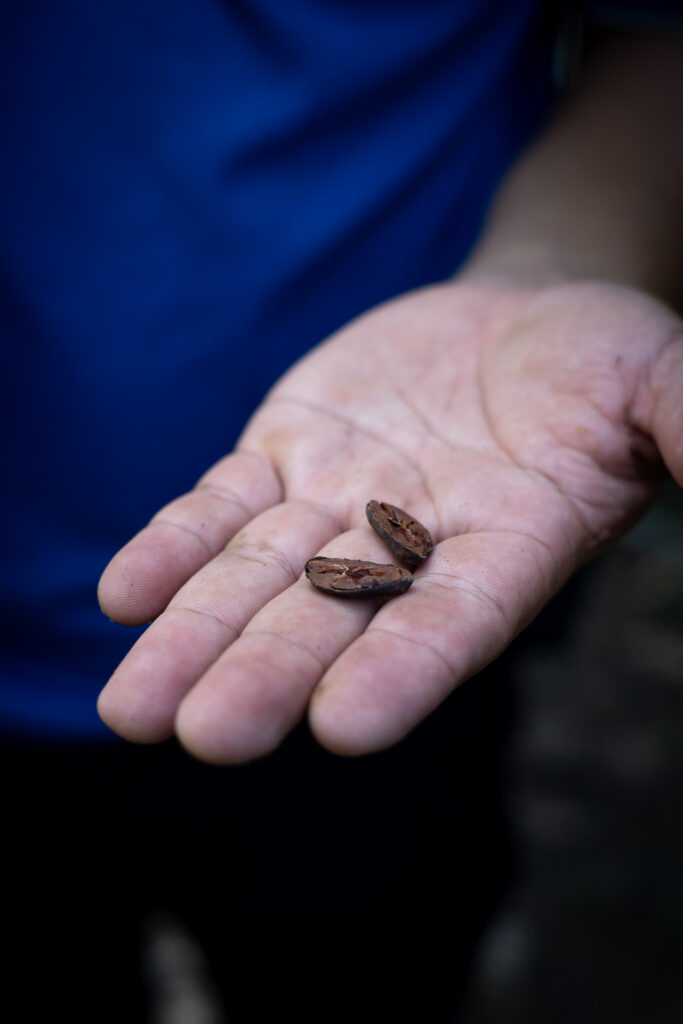
The farm grows 26 proprietary cacao hybrid varieties, named Maleku 1 through Maleku 26. These are non-clonal Trinitario-lineage hybrids – the result of years of on-site selection from random-seeded trees, evaluated for flavor, yield, and adaptability to the specific microclimate of Llano Azul. They are not available anywhere else. They cannot be purchased, licensed, or replicated off this land.

Alongside these proprietary varieties, the farm works with professional clones developed by CATIE (Costa Rica’s Tropical Agricultural Research and Higher Education Center) and proven Trinitario selections from Trinidad. The breeding philosophy is consistent throughout: flavor first, terroir fit second, yield third. That is the inverse of how commodity cacao is farmed, where yield comes first and flavor is an afterthought.

Maleku 2, in particular, is notable for its unusually smooth flavor profile – a trait that has influenced the texture and finish of several bars in the Maleku Chocolate range. The ongoing plan is to graft the best Maleku varieties across the remaining trees, gradually shifting the entire farm toward the flavor profile these varieties have demonstrated.

What this means for the bar in your hands: the genetics in your chocolate exist nowhere else. That is not a slogan. It is a fact of the seed bank.

The Farming: Regenerative, Agroforestry, Whole-Plant

The farm operates under a certified organic agroforestry model. Cacao at Llano Azul is grown under the canopy of shade trees, in a layered system that integrates multiple species in the same space. This is not incidental to the flavor – it is central to it.

Shade-grown cacao develops more slowly than cacao grown in full sun. Slower development means longer time for flavor compounds to accumulate in the bean. The agroforestry canopy also regulates soil temperature and moisture, reduces pest pressure without synthetic inputs, and creates habitat for the insects and birds that support a functioning ecosystem. The farm uses no synthetic chemicals.

Beyond the growing model, Blue Valley Chocolate applies a whole-plant philosophy to the cacao itself. The pod husk, the pulp, the nibs, the shell, the juice – every part of the cacao fruit has a use. Fresh cacao juice and tea, cacao nib products, shell tea in development: nothing from the harvest is wasted. In a commodity supply chain, most of these byproducts are discarded. Here, they are considered part of what the land produces.

The second estate, El Higuerón – approximately 208 acres in Guanacaste – extends this model at larger scale, with a carbon program covering a portion of the property and protected untouched rainforest on the land. Blue Valley Chocolate is not borrowing the language of sustainability from a certification body. It is doing the farming.
The Archaeological Site: Where Cacao and History Meet

In 2019, during cacao planting at Llano Azul, ceramic fragments were found in the soil. Rather than quietly continue, the farm’s then-operator proactively reported the discovery to the National Museum of Costa Rica. The site was investigated, registered, and declared a certified pre-Columbian archaeological monument, given the name “Caju” – the Maleku word for cacao. The site reference is A-549 Ca, associated with the Ron Ron phase (300 BCE to 300 CE).

The cacao trees now growing over the site are, ironically, its best protection. The root systems are shallow, the soil is undisturbed, and no earthworks can take place in the area for the lifetime of the current planting cycle. Blue Valley Chocolate is legally responsible for the conservation of the site under Costa Rica’s heritage law.

Maleku Chocolate is, as far as anyone can determine, the only chocolate maker in the world to protect a certified pre-Columbian archaeological monument on its working farmland. That is a fact with no parallel in the industry.

The Sourcing: No Intermediaries, No Blending

Direct sourcing, in most of the chocolate industry, means a maker who buys directly from a cooperative rather than through a broker. That is an improvement over the commodity model, but it is still an aggregated supply: beans from dozens of farms, blended together, terroir averaged out.

Maleku Chocolate’s sourcing model is simpler and more radical: the beans come from the estate. One farm. Known genetics. Documented post-harvest. The fermentation and sun-drying happen on-site, monitored at every stage. By the time the beans reach the factory in Playa Brasilito, the flavor has been shaped by decisions made at every point from seed selection to drying rack – and every one of those decisions was made by the same team.

The International Chocolate Awards, when it updated its sourcing transparency rules in 2021, created a specific category for this: “Growing Country chocolate,” defined as bars completely produced and packaged within recognized cacao-growing countries, with declared and traceable cacao sources. Maleku Chocolate meets that standard not because a certification says so, but because it was built that way from the beginning.

The Bars: What All of This Tastes Like

Nine international awards – including three Gold medals at the International Chocolate Awards – are the external record of what happens when this land, these genetics, and this sourcing model come together in a finished bar.

The 70% Dark won Gold at the 2018 International Chocolate Awards. The 60% Milk Chocolate with Chili won Gold at the same event. The 60% Milk Chocolate with Coffee won Gold at the 2022 Feria de Chocolate. These are blind-judged competitions, with panels of experienced tasters evaluating against the world’s best craft chocolate. The bars earned those results on flavor alone.

The current range runs from the 40% White Chocolate with Nibs – two ICA silvers, a genuinely unusual bar that showcases the farm’s cacao in its least processed form – through the 56% Milk Chocolate, the 60% Milk Chocolate, the 70% Dark, and the 78% Dark with Orange. All are bean-to-bar, single-estate, additive-free. The cacao in every bar was grown on land with a name, tended by people who know it, and processed without shortcuts.

That is what direct sourcing actually means – not a label, but a chain of decisions that starts in volcanic soil in northern Costa Rica and ends in the bar you are holding.

Explore the full Maleku Chocolate range at malekuchocolate.com/our-products

READ MORE


Why I Invested in These 3 Chocolate Companies: Maleku Chocolate, Blue Valley Chocolate, and MrChoco

By Gideon Rubin

A Market Most Investors Overlook

When people hear “chocolate investment,” they picture Hershey or Lindt. They think commodity. They think saturated. They think: what is left to disrupt?

That framing is exactly why the opportunity exists.

The premium chocolate market was valued at $30.1 billion in 2023 and is projected to reach $46.1 billion by 2028. That is a 53% increase in five years – in a category most sophisticated investors have written off as mature. What is driving it is not new candy bars. It is a structural consumer shift: away from bulk, anonymous chocolate and toward products with traceable origins, ethical production, and genuine craft. Fine-flavor cacao – the kind grown on small farms with identifiable genetics and careful post-harvest processing – commands 20 to 300% price premiums over commodity beans. The supply of it is genuinely scarce. Demand is accelerating.

When I came across this intersection of agricultural scarcity, premiumization, and technology disruption, I did not see a mature market. I saw three distinct entry points, each attacking the opportunity from a different angle.

Investment 1: Maleku Chocolate – The Brand With a Moat Built Over Decades

The first thing that struck me about Maleku Chocolate was not the awards – though nine international honors, including three Gold medals at the International Chocolate Awards, are hard to ignore for a brand operating out of a small farm in northern Costa Rica. It was the specificity of what they had built.

Most chocolate brands are assemblers. They buy cacao from brokers, outsource processing, design packaging, and compete on marketing. Maleku Chocolate is the opposite of that model. The cacao is grown from 26 proprietary hybrid varieties found nowhere else on earth. The fermentation and drying happen on-site, in conditions shaped by the microclimate of the Tenorio Volcano region. The bars are produced in the company’s own factory in Guanacaste with no outside cocoa butter and no commodity blends.

From an investment standpoint, proprietary genetics and in-house post-harvest processing are genuine structural barriers to replication. A competitor cannot simply copy the Maleku Chocolate 70% Dark – they do not have the trees, the soil, or the 26 cacao varieties it took years to develop.

The award record reinforces what the product says. Three Golds at the International Chocolate Awards – for the 70% Dark, the 60% Milk Chocolate with Chili, and the 60% Milk with Coffee at the 2022 Feria de Chocolate – were earned by the brand through blind judging against the world’s best. Those results are not marketing. They are third-party validation of something real happening at the flavor level.

The bet here is straightforward: as premium chocolate consumers become more sophisticated, the brands with genuine provenance and verifiable craft will pull away from those without it. Maleku Chocolate has the provenance. It has the craft. The growth runway is significant, and the moat is already built.

Investment 2: Blue Valley Chocolate – The Infrastructure Play

If Maleku Chocolate is the brand, Blue Valley Chocolate is the platform underneath it.

Blue Valley Chocolate is the vertically integrated operation that makes Maleku Chocolate possible: two farm estates covering approximately 241 acres near the Tenorio Volcano, an on-site factory in Playa Brasilito, a retail store, a wholesale channel serving luxury hospitality partners including Four Seasons Resort Costa Rica and Hacienda Pinilla, and a growing agritourism program that brings paying visitors directly into the chocolate-making process.

Vertical integration in food is rare and valuable. When a company owns the farm, the fermentation, the factory, and the retail relationship, it controls quality at every step – and it captures margin at every step. Most chocolate brands give away the highest-margin parts of the chain to intermediaries. Blue Valley Chocolate has eliminated that.

What makes this particularly interesting as an investment is the diversification of revenue streams from a single asset base. The same cacao trees generate income from wholesale bar sales, from D2C e-commerce, from hospitality supply contracts, and from on-site experiences priced at $55 to $80 per person. When one channel softens – as wholesale can during economic slowdowns – the others buffer it. That structural resilience is rare in small food businesses.

There is also a differentiation claim that no other chocolate maker in the world can match: Blue Valley Chocolate’s Llano Azul farm is the only chocolate-making operation on earth to protect a certified pre-Columbian archaeological monument on its working farmland. That is not a marketing line. It is a registered fact, confirmed by the National Museum of Costa Rica. In a market where every brand claims to be “authentic” and “rooted in place,” Blue Valley Chocolate has something genuinely irreplaceable.

The investment thesis here is infrastructure plus optionality. The hard work of building vertically integrated supply in a fine-flavor origin is already done. The question is how many channels and markets it can serve.

Investment 3: MrChoco – The Technology Layer the Industry Does Not Have Yet

The third investment is the most forward-looking, and the one I find hardest to explain quickly – which usually means it is the most interesting.

MrChoco (mrchoco.com) is an AI-powered chocolate intelligence platform. At its core, it does something that sounds simple but is technically complex: it matches individual consumers to chocolate products based on their flavor preferences, using a recommendation engine trained on metabolomic profiles, sensory data, and tasting history.

Think of it as Spotify for chocolate discovery. Research shows that 74% of consumers say they want to discover new tastes, but the tools to guide that discovery have never existed for chocolate. Wine has sommeliers and structured vocabulary. Coffee has flavor wheels and roast profiles. Chocolate – despite being a product with more flavor compounds than either – has been sold largely on brand recognition and price point. MrChoco is building the infrastructure to change that.

The technology runs deeper than recommendations. IoT sensors are deployed on fermentation and drying processes at the farm level, feeding real-time environmental data into quality models. AI handles compliance automation for organic certification workflows – a process that is currently manual, expensive, and error-prone across the industry. Barry Callebaut has built AI traceability tools for its own supply chain. Mars uses generative AI for recipe development. MrChoco is bringing that same class of technology to the craft and specialty tier, where it does not yet exist.

The platform is consumer-facing today. The long-term opportunity is becoming the data layer that connects craft producers, specialty retailers, and discerning consumers worldwide – a position that, once established, has significant network-effect defensibility.

I will be presenting MrChoco at CES 2027. The audience interaction model is deliberately demonstrative: visitors take a question-based palate test in the app, receive a prediction of which bar they will prefer, taste the bar, and see how well the model performed. That loop – predict, taste, confirm, record – is how you build a palate database at scale. And a palate database at scale, in a premiumizing market, is a genuinely valuable asset.

Why Now

Three forces are converging that make this moment specifically interesting.

First, the commodity chocolate supply chain is under structural pressure. Cacao prices hit record highs in 2024 due to weather-related crop failures in West Africa. When commodity input costs spike, it accelerates the market’s interest in alternative models – smaller, more controlled, more resilient supply chains like the one Blue Valley Chocolate has already built.

Second, consumer sophistication is compounding. The cohort of consumers who can articulate the difference between Criollo and Trinitario cacao, who read origin labels, and who seek out bean-to-bar chocolate is growing every year. These are not niche enthusiasts anymore. They are a mainstream premium consumer segment, the same demographic that drove the specialty coffee and craft spirits markets from niche to dominant in a single decade.

Third, the technology infrastructure to serve this segment – discovery tools, traceability platforms, quality data – is being built right now, in this cycle. Being early to the data layer is how you own the category.

Each of the three investments I have made sits at one of these three forces: Maleku Chocolate at the premium brand level, Blue Valley Chocolate at the supply chain and infrastructure level, and MrChoco at the data and technology level. Together, they are not three separate bets. They are a thesis played across three positions in the same emerging value chain.

The chocolate market is not mature. It is restructuring. And the companies that own the farm, the flavor, and the data when that restructuring completes will have built something that cannot be easily replicated.

That is why I invested.

Interested in the Maleku Chocolate and Blue Valley Chocolate product range? Visit bluevalleychocolate.com. To explore MrChoco, visit mrchoco.com.

READ MORE