The Maleku Chocolate Story: Indigenous Land, Regenerative Cacao, and the Bar in Your Hands
By Gideon Rubin in Uncategorized Posted June 29, 2026 Tags costa rican chocolate,kosher chocolate,maleku costa rica,native group,organic cacao,upala,vegan chocolate
A Name That Carries Responsibility
Most chocolate brands name themselves after founders, places, or feelings. Maleku Chocolate is named after a people.
The Maleku are an indigenous community of northern Costa Rica, concentrated in the Alajuela province around the Upala canton – the same territory where Blue Valley Chocolate’s Llano Azul farm grows the cacao that goes into every Maleku Chocolate bar. The Maleku language has its own word for cacao: caju. It is the same word given to the certified pre-Columbian archaeological site discovered on the farm itself in 2019, registered by the National Museum of Costa Rica and now protected under Costa Rican heritage law.
Carrying that name is not a branding exercise. It is an acknowledgment that this land has a history longer than any chocolate company – and a commitment to tend it accordingly.
The Land: A Rare Origin in a Country of Rare Origins
Costa Rica is already a specialty origin. Its cacao represents a small fraction of global production, and within the country, most farms are concentrated in the Caribbean lowlands of the Limon province – the traditional cacao-growing belt. The Alajuela/Upala region where Maleku Chocolate’s cacao is grown is classified as a non-traditional, low-density zone: fewer farms, fewer intermediaries, and a terroir shaped by forces the Caribbean coast simply does not have.
The Llano Azul farm sits at the base of Tenorio Volcano, approximately 7 km south of Upala in northern Costa Rica. The soil is volcanic – mineral-rich, slightly acidic, and free of the cadmium contamination that has become a growing problem for cacao regions elsewhere in Latin America. The farm receives a mix of Caribbean and Pacific climatic influences, an atmospheric combination that produces cacao with earthy, mineral flavor characteristics not found in beans from more conventional origins.
In the language of specialty chocolate sourcing, low farm density in a region means inherently stronger traceability. There are no cooperatives blending dozens of farms together, no commodity aggregators diluting origin character. When a bar says Llano Azul, it means Llano Azul. That kind of precision is what separates provenance from marketing.
The Cacao: 26 Varieties Found Nowhere Else on Earth
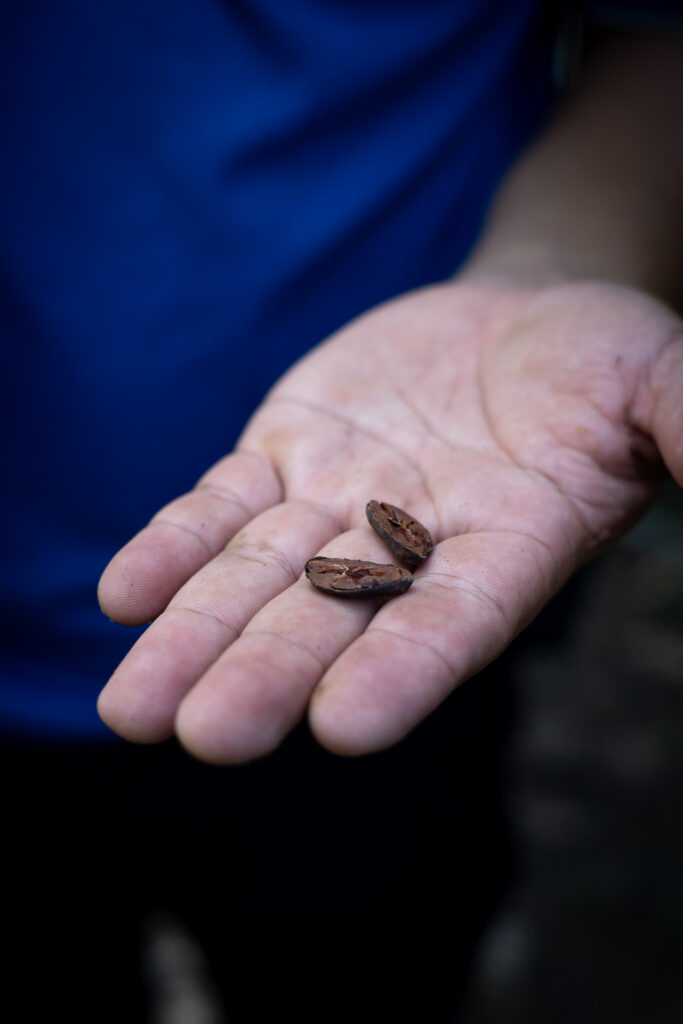
The farm grows 26 proprietary cacao hybrid varieties, named Maleku 1 through Maleku 26. These are non-clonal Trinitario-lineage hybrids – the result of years of on-site selection from random-seeded trees, evaluated for flavor, yield, and adaptability to the specific microclimate of Llano Azul. They are not available anywhere else. They cannot be purchased, licensed, or replicated off this land.
Alongside these proprietary varieties, the farm works with professional clones developed by CATIE (Costa Rica’s Tropical Agricultural Research and Higher Education Center) and proven Trinitario selections from Trinidad. The breeding philosophy is consistent throughout: flavor first, terroir fit second, yield third. That is the inverse of how commodity cacao is farmed, where yield comes first and flavor is an afterthought.
Maleku 2, in particular, is notable for its unusually smooth flavor profile – a trait that has influenced the texture and finish of several bars in the Maleku Chocolate range. The ongoing plan is to graft the best Maleku varieties across the remaining trees, gradually shifting the entire farm toward the flavor profile these varieties have demonstrated.
What this means for the bar in your hands: the genetics in your chocolate exist nowhere else. That is not a slogan. It is a fact of the seed bank.
The Farming: Regenerative, Agroforestry, Whole-Plant
The farm operates under a certified organic agroforestry model. Cacao at Llano Azul is grown under the canopy of shade trees, in a layered system that integrates multiple species in the same space. This is not incidental to the flavor – it is central to it.
Shade-grown cacao develops more slowly than cacao grown in full sun. Slower development means longer time for flavor compounds to accumulate in the bean. The agroforestry canopy also regulates soil temperature and moisture, reduces pest pressure without synthetic inputs, and creates habitat for the insects and birds that support a functioning ecosystem. The farm uses no synthetic chemicals.
Beyond the growing model, Blue Valley Chocolate applies a whole-plant philosophy to the cacao itself. The pod husk, the pulp, the nibs, the shell, the juice – every part of the cacao fruit has a use. Fresh cacao juice and tea, cacao nib products, shell tea in development: nothing from the harvest is wasted. In a commodity supply chain, most of these byproducts are discarded. Here, they are considered part of what the land produces.
The second estate, El Higuerón – approximately 208 acres in Guanacaste – extends this model at larger scale, with a carbon program covering a portion of the property and protected untouched rainforest on the land. Blue Valley Chocolate is not borrowing the language of sustainability from a certification body. It is doing the farming.
The Archaeological Site: Where Cacao and History Meet
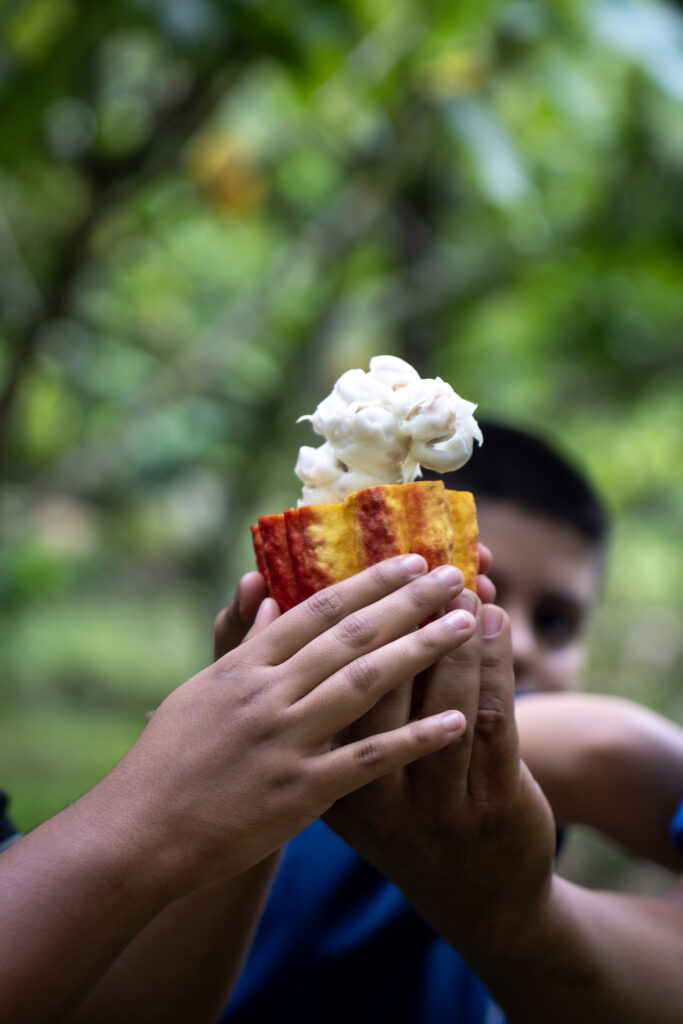
In 2019, during cacao planting at Llano Azul, ceramic fragments were found in the soil. Rather than quietly continue, the farm’s then-operator proactively reported the discovery to the National Museum of Costa Rica. The site was investigated, registered, and declared a certified pre-Columbian archaeological monument, given the name “Caju” – the Maleku word for cacao. The site reference is A-549 Ca, associated with the Ron Ron phase (300 BCE to 300 CE).
The cacao trees now growing over the site are, ironically, its best protection. The root systems are shallow, the soil is undisturbed, and no earthworks can take place in the area for the lifetime of the current planting cycle. Blue Valley Chocolate is legally responsible for the conservation of the site under Costa Rica’s heritage law.
Maleku Chocolate is, as far as anyone can determine, the only chocolate maker in the world to protect a certified pre-Columbian archaeological monument on its working farmland. That is a fact with no parallel in the industry.
The Sourcing: No Intermediaries, No Blending
Direct sourcing, in most of the chocolate industry, means a maker who buys directly from a cooperative rather than through a broker. That is an improvement over the commodity model, but it is still an aggregated supply: beans from dozens of farms, blended together, terroir averaged out.
Maleku Chocolate’s sourcing model is simpler and more radical: the beans come from the estate. One farm. Known genetics. Documented post-harvest. The fermentation and sun-drying happen on-site, monitored at every stage. By the time the beans reach the factory in Playa Brasilito, the flavor has been shaped by decisions made at every point from seed selection to drying rack – and every one of those decisions was made by the same team.
The International Chocolate Awards, when it updated its sourcing transparency rules in 2021, created a specific category for this: “Growing Country chocolate,” defined as bars completely produced and packaged within recognized cacao-growing countries, with declared and traceable cacao sources. Maleku Chocolate meets that standard not because a certification says so, but because it was built that way from the beginning.
The Bars: What All of This Tastes Like
Nine international awards – including three Gold medals at the International Chocolate Awards – are the external record of what happens when this land, these genetics, and this sourcing model come together in a finished bar.
The 70% Dark won Gold at the 2018 International Chocolate Awards. The 60% Milk Chocolate with Chili won Gold at the same event. The 60% Milk Chocolate with Coffee won Gold at the 2022 Feria de Chocolate. These are blind-judged competitions, with panels of experienced tasters evaluating against the world’s best craft chocolate. The bars earned those results on flavor alone.
The current range runs from the 40% White Chocolate with Nibs – two ICA silvers, a genuinely unusual bar that showcases the farm’s cacao in its least processed form – through the 56% Milk Chocolate, the 60% Milk Chocolate, the 70% Dark, and the 78% Dark with Orange. All are bean-to-bar, single-estate, additive-free. The cacao in every bar was grown on land with a name, tended by people who know it, and processed without shortcuts.
That is what direct sourcing actually means – not a label, but a chain of decisions that starts in volcanic soil in northern Costa Rica and ends in the bar you are holding.
Explore the full Maleku Chocolate range at malekuchocolate.com/our-products
READ MORE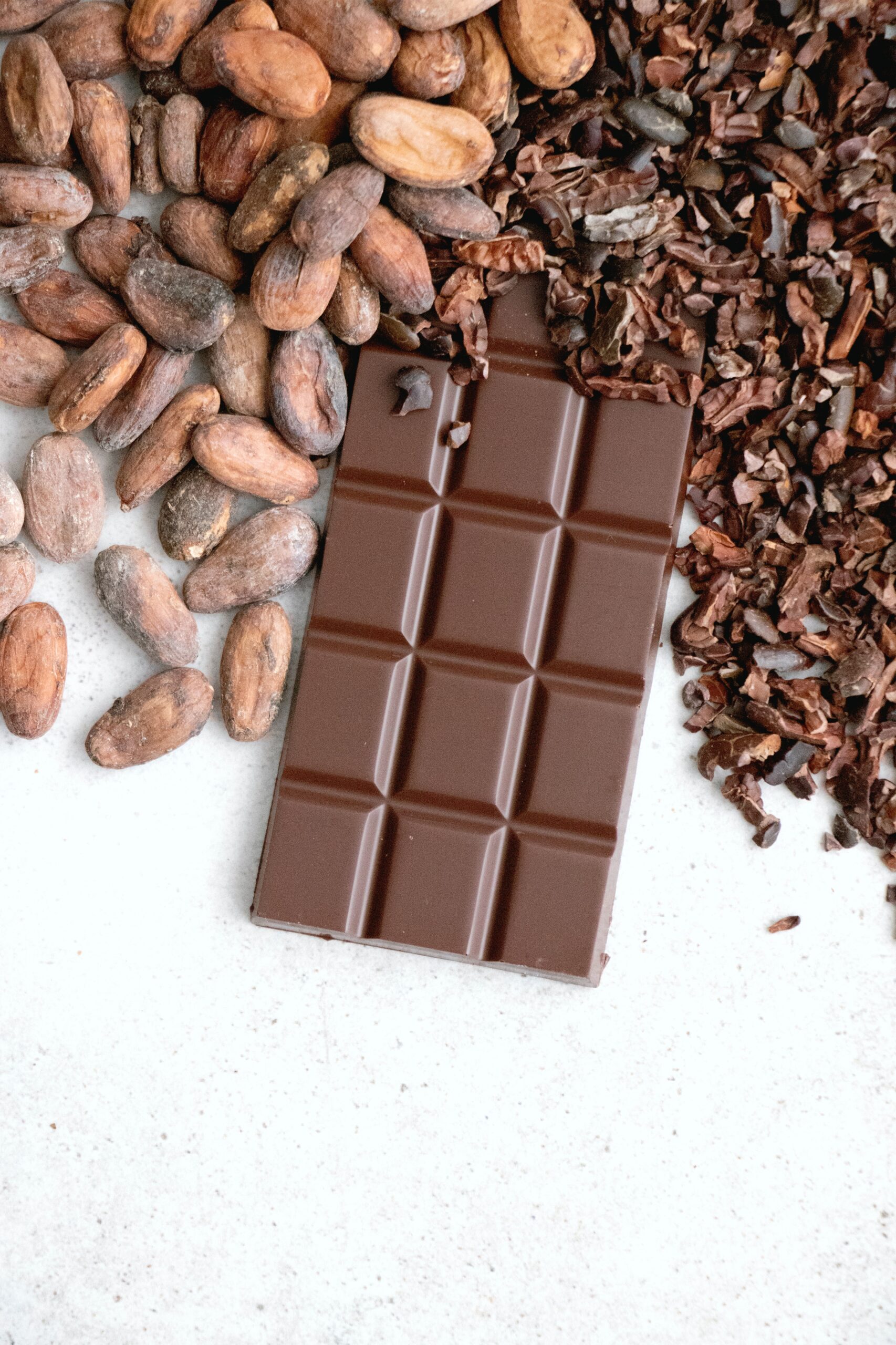





Recent Comments